CeFi Crypto-Lending Business Models: Retail vs Corporate vs Institutional
The difference between business models from an operations perspective.
PERSPECTIVE
Mark Kendall
2/4/2026
Retail CeFi Lending (B2C)
Why operators are drawn to it
Retail platforms scale fast. Customer acquisition is straightforward. Margins look attractive. Thousands of small depositors feel safer than a handful of whales.
The real advantages
Diversified deposit base
No single depositor can sink you.Attractive headline spreads
Retail pays low single-digit yield; loans can price much higher.Sticky behavior in calm markets
Many users treat accounts like savings, not trading capital.Simple product story
“Earn yield on your crypto” doesn’t require education.
Where the model breaks
Retail runs are violent and synchronized
When confidence breaks, withdrawals are simultaneous and emotional.Liabilities are callable; assets usually aren’t
If loans or collateral settle slower than withdrawals, liquidity disappears fast.Heavy regulatory exposure
Consumer protection, disclosures, marketing claims, and suitability rules all apply.Operational drag
Support, UX failures, KYC friction, and withdrawal queues become existential under stress.
---> Operating reality:
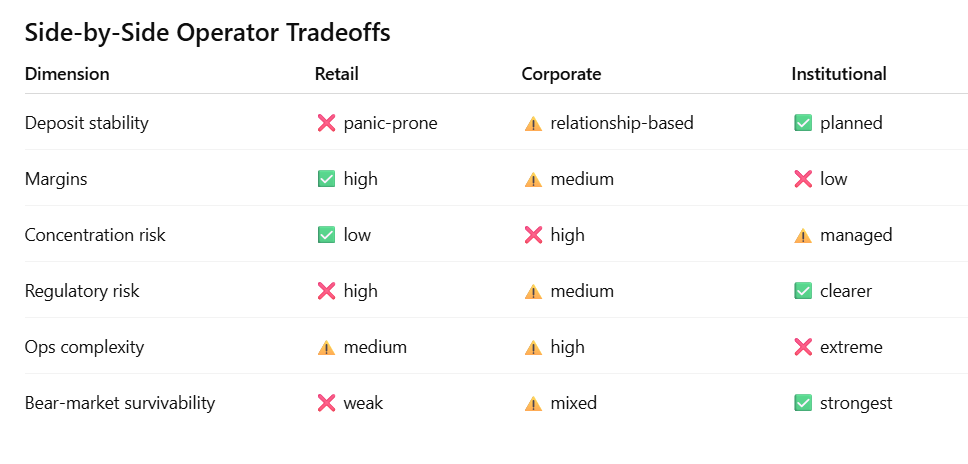
Retail lending survives bull markets easily — and collapses quickly in crises if liquidity is even slightly mismatched.
Corporate / SME Crypto Lending (B2B)
Corporate lending sits in the middle ground: fewer customers, larger balances, and real underwriting.
After surviving (or witnessing) retail chaos, many platforms pivot to B2B for more control and predictability.
The real advantages
Relationship-driven capital
CFOs don’t withdraw because of social media sentiment.Customizable terms
Lockups, margin thresholds, covenants, and reporting requirements are standard.Lower servicing overhead per dollar
One relationship can represent millions in volume.Reduced consumer regulatory pressure
Sophisticated counterparties carry more responsibility.
Where operators get burned
Concentration risk is real
Losing one or two borrowers can destabilize the entire loan book.Liquidity becomes lumpy
Large repayments or margin calls distort cash flows.Credit mistakes are visible immediately
There’s no hiding bad underwriting behind averages.Legal and operational complexity rises fast
Docs, collateral management, and bespoke terms require real infrastructure.
-----> Operating reality:
Corporate lending rewards discipline — and punishes shortcuts brutally.
Institutional CeFi Lending (Prime / Capital Markets)
This is the least flashy and most survivable model — and the hardest to execute.
Why operators aim for it
Institutions behave predictably. Liquidity is planned. Risk frameworks are explicit. Capital tends to stay put longer.
The real advantages
Planned liquidity behavior
Institutions forecast needs weeks or months ahead.Sophisticated counterparties
Margining, stress testing, and collateral haircuts are expected.Lower regulatory ambiguity
Risk disclosures and documentation are standard.Multi-product flywheels
Lending connects naturally to custody, OTC, derivatives, and financing.
The hard truths
Margins are thin
You’re competing with banks and global prime desks.Operational failure is fatal
One margining or settlement error can end the business.High fixed costs
Risk systems, legal teams, and experienced talent are non-negotiable.Reputation matters more than yield
Trust compounds slowly and disappears instantly.
----> Operating reality:
This model is boring, expensive, and resilient — exactly why it survives bear markets.